
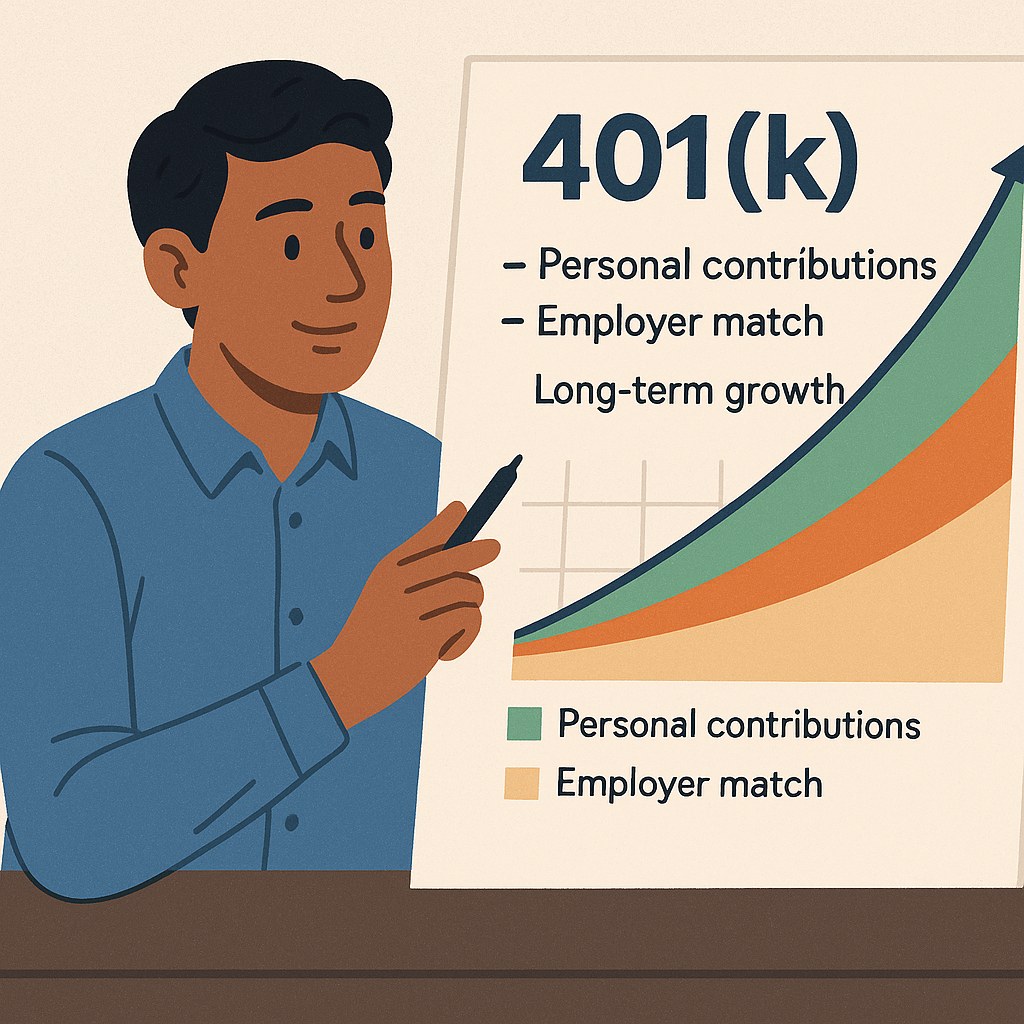
When you receive your paycheck, you might notice more than just taxes deducted. There's often a separate entry for contributions to your company's 401(k) plan. You might be wondering if you're making the most of this retirement savings opportunity, especially when your employer offers a matching contribution. Unlike savings in your regular bank account, a 401(k) provides potential tax benefits and an automatic way to invest a portion of your salary for retirement. One crucial advantage is the employer match, which can significantly boost your savings if used effectively.
Key Takeaways
- A 401(k) is a retirement savings plan funded through pre-tax payroll deductions and possible employer contributions.
- Employer matching means your employer contributes an additional amount to your 401(k) based on your contributions, usually up to a certain percentage.
- To maximize benefits, contribute enough to get the full employer match; it's essentially free money added to your retirement savings.
- Understand contribution limits: For 2026, the IRS has set the limit at $24,500 IRS 2026 retirement-plan contribution limits.
- Calculations for matching and contributions can be complex but are made easier with tools like the 401(k) Employer Match Calculator.
What Is a 401(k)?
A 401(k) is a type of retirement savings plan sponsored by your employer. It enables you to save for retirement while enjoying certain tax benefits. Contributions are made directly from your paycheck before taxes, reducing your taxable income for the year. This not only helps in growing your savings through investments but also in deferring income taxes until you withdraw funds in retirement.
401(k) plans often offer a variety of investment options, such as mutual funds, stocks, bonds, or target-date funds, allowing you to tailor your approach to your financial goals and risk tolerance.
How Does Employer Matching Work?
Employer matching is a feature of 401(k) plans where your employer matches a portion of the contributions you make to your retirement account, effectively boosting your savings without additional cost to you. A common setup is a dollar-for-dollar match on the first 3% of your salary you contribute, followed by 50 cents on the dollar for the next 2%. This means if you contribute 5% of your salary, your employer contributes an additional 4% of your salary.
Here's a simple illustration:
- Your Salary: $60,000 annually
- Your Contribution Rate: 5%
- Employer Match Scheme: 100% of the first 3%, 50% of the next 2%
In this scenario, you'd contribute 2,400, totaling $5,400 towards your retirement annually.
Assumptions Used in This Example
- Salary considered is $60,000.
- The contribution rate is 5% of the annual salary.
- Employer match is 100% for the first 3% and 50% for the next 2%.
- No consideration of salary increases, investment returns, or inflation adjustments.
Maximizing Your 401(k) Match
To capture your full employer match, you should contribute at least up to the point where the employer stops matching. Failing to do so means missing out on potential contributions. It's crucial to adjust your monthly or per-paycheck contribution rate accordingly, ensuring you're maximizing the match without exceeding your budget.
Data Snapshot
| Year | Your Contribution | Employer Contribution | Total Contribution |
|---|---|---|---|
| 2026 | $3,000 | $2,400 | $5,400 |
For those maximizing their 401(k) employer match, this snapshot demonstrates a potential strategy for growing retirement savings.
Why Employer Match Matters
Employer matches are essentially free money for your future. They can significantly increase the total amount saved, enhancing the power of compound growth over time. This benefit also boosts your plan's investment without altering your monthly budget because it’s an addition, not a deduction.
To see how different contribution rates affect your savings, consider exploring the 401(k) Employer Match Calculator. This tool helps test various scenarios and understand the potential impact of employer contributions on long-term retirement savings.
Understanding Vesting Periods
Employer contributions might be subject to a vesting schedule, meaning you earn ownership of matched funds over time. If you leave your job before being fully vested, you may forfeit some or all of the employer's contributions. This varies by company and can stretch over several years, so it's wise to understand your plan’s specific vesting rules. More details can be found in the IRS retirement plan vesting guidance.
Evaluating Long-Term Growth
The value of your 401(k) not only includes your savings and employer match but also the accumulated earnings over years of investing. The magic of compounding means your growth could accelerate as investment returns generate their own returns. To illustrate, let's examine how a $5,400 annual contribution might grow:
If invested in a portfolio earning an average of 5% annually, within 30 years, your account could potentially grow to over $400,000. This calculation assumes reinvestment of earnings and consistent annual contributions.
Comparing 401(k) Options with Other Plans
While a 401(k) might be the most popular choice for employer-based retirement saving, knowing how it compares with other retirement accounts can aid better planning:
| Feature | 401(k) | Traditional IRA |
|---|---|---|
| Contribution Limits | Higher; up to $24,500 in 2026 (including catch-up) | Lower; $7,500 for those 50 and above in 2026 |
| Employer Match | Possible | Not available |
| Tax Treatment | Pre-tax contributions, taxed at withdrawal | Similar tax benefits but not employer-supported |
The higher contribution limits and potential employer match make 401(k)s an attractive choice for maximizing retirement savings.
Portfolio Diversification within Your 401(k)
Selecting the right investment mix within your 401(k) is crucial for balancing risk and growth potential. While the plan usually offers various options like mutual funds, stocks, and bonds, it's essential to align these choices with your risk tolerance, investment horizon, and retirement goals.
A common strategy is to diversify across asset classes to mitigate risk. For example, younger investors might focus more heavily on stocks due to their potential for higher returns over the long term, accepting the volatility. As you approach retirement, a shift towards bonds can provide more stability and preserve capital.
Adjusting Contributions for Income Changes
Life events, such as a salary increase or a reduction, might prompt a reevaluation of your 401(k) contributions. When you receive a pay raise, consider increasing your contribution rate to enhance the growth of your savings without affecting your current lifestyle significantly. For instance, allocating half of a 5% salary increase towards your 401(k) boosts your retirement savings while enjoying the other half's benefits immediately.
On the other hand, if your income decreases, you may need to adjust your contributions accordingly. While it's crucial to keep contributing enough to capture any employer match, balance this with other financial responsibilities. Regularly revisiting your contribution levels ensures that your retirement planning remains aligned with your financial position.
Explaining the Impact of Fees
Fees are an often-overlooked aspect of 401(k) plans, yet they can substantially affect long-term savings. Plans typically incur administrative, management, and fund-specific fees, which are deducted from your account balance over time. The lower the fees, the more of your money stays in your investment, compounding towards retirement.
For example, if your 401(k) incurs a 1% annual fee versus a 0.5% fee, the difference may appear small but can cost thousands in lost earnings over decades. It’s wise to review fee disclosures regularly and consider adjusting your asset allocation within the plan to minimize these costs while meeting your investment goals.
Considering Roth 401(k) Options
Some employers offer Roth 401(k) options, allowing for tax-free growth and withdrawals in retirement. Contributions are made with post-tax dollars, which means they're not deductible in the current year. However, qualified withdrawals during retirement are tax-free, provided the account has been held for at least five years and you’re over 59½.
Choosing between traditional and Roth 401(k) options depends on your current tax rate versus your expected retirement tax rate. If you anticipate being in a higher tax bracket later, a Roth option could be advantageous. Conversely, a traditional 401(k) may be better if your current tax rate is higher than what you expect in retirement.
The Importance of Reviewing Your Plan Regularly
It's vital to regularly review your 401(k) plan to ensure it remains aligned with your financial situation and retirement goals. Life events such as marriage, divorce, or the birth of a child may impact your savings strategy. Also, changes in the job market or the broader economy could necessitate different investment approaches.
Annual reviews allow you to adjust your contributions, reassess employer match levels, revisit investment choices, and update beneficiary information. With each evaluation, leverage resources like the 401(k) Employer Match Calculator to simulate adjustments and their potential impacts on your retirement savings.
The Role of Contribution Limits in Retirement Planning
Understanding the annual contribution limits for 401(k) plans is crucial, as it directly impacts how much you can set aside for retirement each year. In 2026, the IRS has set the limit at $24,500, which includes any additional contributions allowed for those 50 and over. These limits ensure that savings enjoy the full benefit of the annual tax advantage and employer matching IRS 401(k) contribution limits.
Growth Potential of Maximizing Contributions
Maximizing contributions can significantly enhance your retirement savings through strategic planning. For instance, if you’re eligible for catch-up contributions due to age, each additional dollar saved benefits from tax-deferred growth. If you manage to contribute the full 315,500, not accounting for the employer match, which could take this estimate even higher.
Implications for High Earners
For high earners, consistent maximization is vital. Reaching this threshold as early in the year as possible offers more time for investments to grow tax-deferred. However, ensure your contributions don't exceed limits as this could trigger penalties and tax complications. Plan throughout the year, considering bonuses or other compensation forms that might unintentionally push you over the cap.
Understanding Vesting and Its Impact
Vesting schedules can differ among employers, determining when you fully 'own' the matched contributions to your 401(k). It’s vital to understand these terms because leaving a job prior to vesting completion might result in forfeiting a portion of the employer’s contributions IRS retirement-plan vesting guidance.
Types of Vesting Schedules
- Immediate Vesting: You gain ownership of employer contributions right away.
- Cliff Vesting: All at once after a specific period, usually 3 years.
- Graded Vesting: Ownership increases incrementally, often over several years.
Effects of Changing Jobs
When job changes are imminent, evaluate the current vesting schedule and its impact on your total retirement savings. If you’re close to reaching full vesting, it may be financially beneficial to remain until fully vested. To make informed decisions, calculate the value of the vested match you’d forfeit and weigh it against any benefits of moving to new employment.
Verification and Adjustment of Personal Inputs
Making the most of your 401(k) involves regular verification of inputs and adjusting as needed. This process begins with reviewing your salary, match criteria, and personal contribution levels. Periodic adjustments ensure your plan aligns with life changes or evolving financial goals.
Steps for Accurate Verification
- Audit Contribution Levels: Confirm current contribution levels match your intended savings strategy.
- Review Employer Match Terms: Verify if changes in company policy affect your matching percentage.
- Assess Vesting Status: Regularly check your current vesting status to understand future benefit access.
Tools for Real-Time Adjustments
Utilizing publicly available tools like the 401(k) Employer Match Calculator can help you test modifications in contribution levels or potential salary changes. These simulations provide insights into how adjustments could impact your retirement savings trajectory, allowing for better financial planning and decision-making.
Through careful attention to such details, you maintain a robust retirement savings plan that aligns with your long-term financial objectives. Regular reviews and adjustments enhance your ability to make informed, strategic decisions regarding your 401(k) and employer contribution match.
Frequently Asked Questions
What happens if I don't contribute to my 401(k)?
If you don't contribute to your 401(k), you miss out on potential employer matches and fail to take advantage of tax-advantaged savings. Over time, this decision can significantly reduce your retirement nest egg due to the lost contributions and compounded growth.
Can I access funds in my 401(k) before retirement?
While technically possible, withdrawing funds from a 401(k) before retirement isn't advisable due to penalties and taxes. Early withdrawals typically incur a 10% penalty in addition to regular income taxes, which can erode your savings significantly.
How do contribution limits affect high earners?
For high earners, hitting the maximum contribution limit can be straightforward. Paying attention to IRS updates—like the 2026 cap of $24,500—is crucial. Contributions beyond the limit must be planned through other tax-advantaged accounts, such as an IRA.
Methodology
This guide uses estimates based on a set of assumptions relevant to the current economic environment as of October 11, 2026. Contributions, matching, and investment performance data reflect typical plan structures and may vary by employer. Calculations illustrate compound growth using a 5% annual return assumption over 30 years. All monetary figures are expressed in constant 2026 dollars, with no adjustments for inflation or future economic conditions. For further accuracy, figures are rounded to the nearest dollar unless otherwise specified.
Final Thoughts
Effectively managing your 401(k) involves understanding how employer matching works, making informed decisions about contributions, and regularly reviewing your investment strategy. Adjusting contributions according to personal financial changes, being mindful of fees, and considering Roth options are all essential parts of this process. With tools like the 401(k) Employer Match Calculator, you can explore various scenarios to ensure you're optimizing your retirement plan.
Educational Disclaimer
The information provided here is for educational purposes only and should not be considered financial or legal advice. Always consult with a financial advisor or tax professional to ensure that your retirement strategy aligns with your personal circumstances and verify details with relevant official sources before making investment decisions.