
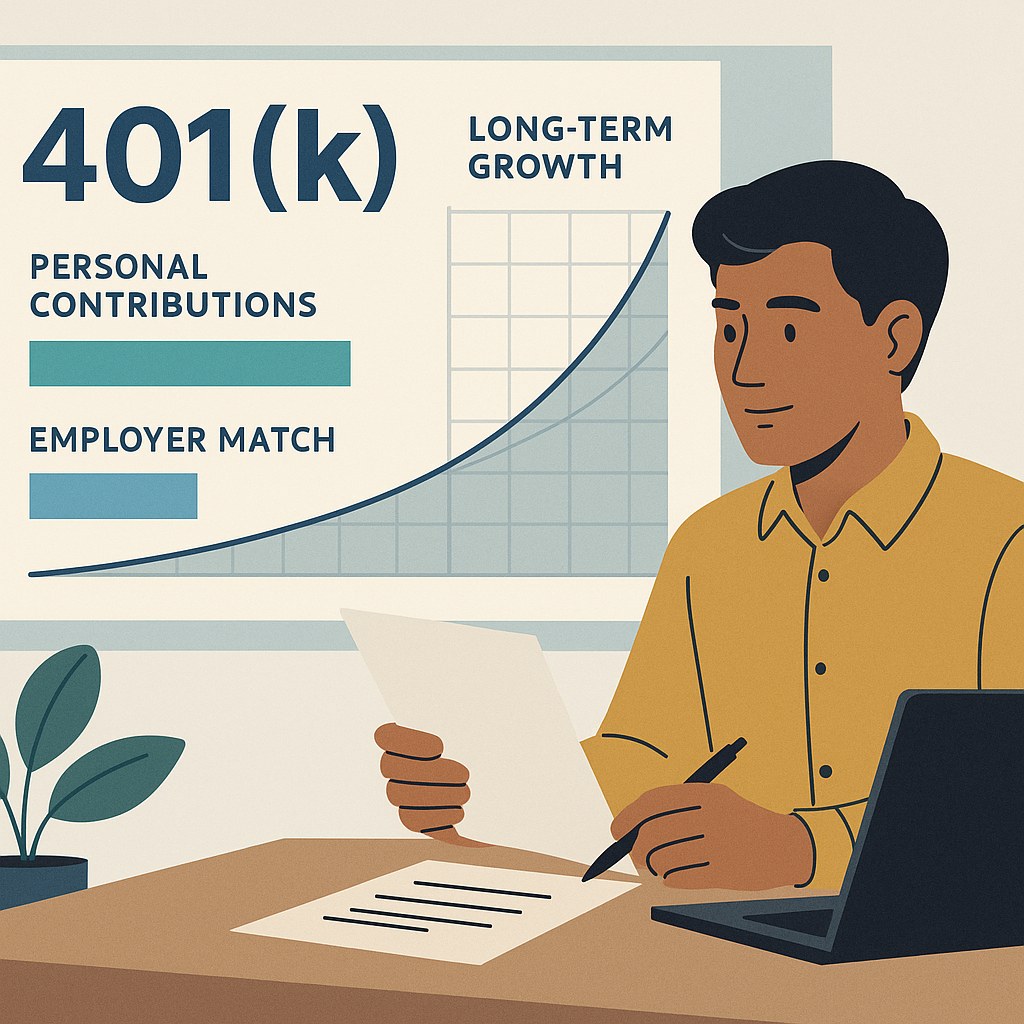
An employer match can be one of the most valuable parts of a workplace retirement plan. But receiving the full match is not always as simple as contributing to your 401(k).
You need to understand the employer’s matching percentage, the compensation limit, how often the match is deposited, whether the plan provides a year-end true-up, and how long it takes for employer contributions to become fully vested.
A 401(k) match calculator can help with the arithmetic. Your plan documents explain the rules the calculator needs to model.
Key Takeaways
- An employer match is an employer contribution based on the formula established by your retirement plan.
- “50% match up to 6% of pay” does not mean the employer contributes 6% of your salary. It generally means the maximum employer contribution is 3%.
- To receive the full available match, you usually must contribute at least the percentage required by the plan.
- Contributions above the matching threshold may increase your savings, but they may not produce additional employer contributions.
- Your own contributions are always vested, but employer contributions may follow a vesting schedule.
- Some employers calculate matches each pay period. Contributing too much too early could reduce your total match if the plan does not provide a true-up.
- For 2026, the employee elective-deferral limit for most 401(k) plans is $24,500, with additional catch-up limits for eligible participants.
What Is a 401(k) Employer Match?
A 401(k) employer match is money an employer contributes to an employee’s retirement account based on the employee’s own contribution.
A plan might match:
- 100% of employee contributions up to 3% of salary;
- 100% of employee contributions up to 5%;
- 50% of employee contributions up to 6%;
- A tiered percentage at different contribution levels; or
- A fixed employer contribution unrelated to the employee’s contribution.
The IRS explains that employer matching contributions depend on the formula in the plan document. One example is an employer contributing 50 cents for every dollar an employee defers.
Not every employer offers a match, and two employers using similar language may still have different plan rules.
How to Read a Matching Formula
The easiest way to understand a match is to separate two numbers:
- The matching rate: How much the employer contributes for each dollar you contribute.
- The compensation limit: How much of your salary is eligible for the match.
Example: 100% Match Up to 5%
Suppose your plan matches 100% of your contributions up to 5% of eligible salary.
If your annual salary is $60,000, the maximum salary amount used for the match is:
Because the employer matches dollar for dollar, the maximum annual employer contribution is also:
To receive the full $3,000 employer match, you would generally need to contribute at least $3,000 during the applicable plan year and follow the plan’s contribution-timing requirements.
Example: 50% Match Up to 6%
Now suppose the employer matches 50% of your contributions on the first 6% of salary you contribute.
Employee contribution needed to reach the matching limit:
Employer match:
The employee contributes 6% of salary, but the employer contributes a maximum of 3%:
The phrase “50% up to 6%” therefore does not mean the employer contributes 6% of salary.
Are You Receiving the Full Match?
Consider a $60,000 salary with a dollar-for-dollar employer match on employee contributions up to 5% of salary.
The maximum available employer match is:
Data Snapshot
| Employee contribution rate | Employee contribution | Employer match | Total annual contribution | Unclaimed available match |
|---|---|---|---|---|
| 0% | $0 | $0 | $0 | $3,000 |
| 2% | $1,200 | $1,200 | $2,400 | $1,800 |
| 5% | $3,000 | $3,000 | $6,000 | $0 |
| 7% | $4,200 | $3,000 | $7,200 | $0 |
At a 2% contribution rate, the employee receives only $1,200 of the available $3,000 match.
At 5%, the employee receives the full match.
At 7%, the employee saves more personally, but the employer contribution remains capped at $3,000 under this formula.
The Long-Term Cost of Missing Part of the Match
In the example above, contributing 2% instead of 5% leaves $1,800 of employer match unclaimed each year.
If $1,800 were contributed at the end of every year for 30 years and earned an illustrative 7% annual return:
This does not mean the employee is guaranteed to lose $170,029. The result assumes:
- The same match remains available for 30 years;
- The employee remains eligible;
- The contribution is fully vested;
- The money earns exactly 7% every year;
- No fees, loans, or withdrawals occur; and
- Contributions are made at the end of each year.
The example simply illustrates why repeatedly missing part of a match can have a larger long-term effect than the annual amount suggests.
Per-Paycheck Matching Can Change the Result
Many employees focus on the annual contribution percentage but overlook how the employer calculates the match.
Suppose an employer matches contributions every two weeks. If an employee reaches the annual 401(k) contribution limit early and stops contributing during the final pay periods, there may be no employee contribution left for the employer to match on those later paychecks.
Whether the employee eventually receives the missed amount depends on whether the plan offers a true-up contribution.
What Is a True-Up?
A true-up is an additional employer contribution that may be made after the plan year to reconcile the employee’s full-year contributions with the employer’s annual matching formula.
Not every plan provides one.
Before increasing your contribution rate enough to reach the annual limit early, ask:
- Is the match calculated per paycheck or annually?
- Must I contribute during each pay period to receive the match?
- Does the plan provide a year-end true-up?
- Must I still be employed on a particular date to receive the true-up?
- Which forms of compensation are eligible for matching?
A calculator that assumes an annual match may overstate the employer contribution if your plan matches per pay period and does not provide a true-up.
Vesting Determines How Much of the Match You Own
Your own salary-deferral contributions are always 100% vested. Employer contributions may follow a different schedule.
A plan might use:
- Immediate vesting;
- Cliff vesting, where ownership becomes 100% after a specified period; or
- Graded vesting, where ownership increases gradually.
For example, an employer’s plan might use the following graded schedule:
| Years of service | Vested percentage |
|---|---|
| 1 | 0% |
| 2 | 20% |
| 3 | 40% |
| 4 | 60% |
| 5 | 80% |
| 6 | 100% |
If you leave the employer before becoming fully vested, you may forfeit the unvested portion of employer contributions.
The IRS confirms that employee elective deferrals are always fully vested, while employer contributions in a traditional 401(k) may be subject to the vesting schedule in the plan document.
This is why an employer match should be described as part of your potential compensation without assuming every deposited dollar is immediately yours.
What Counts as Eligible Compensation?
A match may be calculated using eligible compensation as defined by the plan—not necessarily every dollar reported as gross pay.
Depending on the plan, eligible compensation may or may not include:
- Base salary;
- Hourly wages;
- Overtime;
- Bonuses;
- Commissions;
- Shift differentials;
- Tips; or
- Pay earned before entering the plan.
For someone earning substantial overtime or bonuses, entering total gross income into a calculator could overstate the match if the plan excludes part of that compensation.
Use the eligible-compensation definition in your Summary Plan Description or benefits materials.
2026 Employee and Total-Plan Limits
Employer contributions do not generally count toward the employee elective-deferral limit. They do count toward a separate overall defined-contribution limit.
For 2026:
| 401(k) limit | 2026 amount |
|---|---|
| Employee elective-deferral limit | $24,500 |
| General age-50 catch-up contribution | $8,000 |
| Total for most participants age 50 or older | $32,500 |
| Higher catch-up for eligible ages 60–63 | $11,250 |
| Total for eligible ages 60–63 | $35,750 |
| General total defined-contribution limit | $72,000 |
The general $72,000 total-plan limit includes applicable employee and employer contributions but generally does not include eligible catch-up contributions.
The IRS announced the $24,500 employee limit, $8,000 general catch-up, $11,250 higher catch-up for eligible participants ages 60 through 63, and $72,000 general defined-contribution limit for 2026.
Plan provisions, compensation limits, nondiscrimination rules, and individual circumstances can affect the amount that may actually be contributed.
Traditional and Roth Contributions May Both Count Toward the Match
A plan may permit:
- Traditional pretax contributions;
- Roth 401(k) contributions; or
- A combination of both.
Traditional and Roth employee deferrals generally share the same annual employee contribution limit. Whether both types qualify for the employer match depends on the plan terms, although many plans match either form of elective deferral.
Employer matching contributions have historically been deposited into a pretax account, but plan provisions and newer Roth-matching options can affect tax treatment. Confirm how your plan handles the match rather than assuming it follows your employee contribution type.
How to Calculate Your Full Employer Match
Use the following process.
Step 1: Find Your Eligible Annual Compensation
Do not automatically use total income if the plan excludes bonuses, overtime, or another form of pay.
Step 2: Identify the Matching Formula
For example:
- 100% of the first 3%;
- 50% of the first 6%; or
- 100% of the first 3% plus 50% of the next 2%.
Step 3: Calculate the Contribution Needed
For a 50% match on the first 6% of $60,000:
The employee generally needs to contribute $3,600 to reach the full matching threshold.
Step 4: Calculate the Employer Contribution
Step 5: Check Paycheck Timing
For 26 biweekly paychecks:
The employee would need to contribute approximately $138.46 from each regular paycheck to spread the 6% contribution evenly across the year, assuming consistent eligible pay.
Step 6: Review Vesting
Determine how much of the projected employer contribution would belong to you if you left your job before the end of the vesting period.
What to Look for in a Public 401(k) Match Calculator
A useful calculator should allow you to enter:
- Annual eligible salary;
- Employee contribution percentage or dollar amount;
- Employer matching rate;
- Maximum percentage of pay eligible for the match;
- Pay frequency;
- Current account balance;
- Current age;
- Retirement age;
- Estimated investment return;
- Salary growth;
- Vesting assumptions; and
- Contribution frequency.
Check whether the calculator correctly distinguishes between:
- “100% match up to 5%”; and
- “50% match up to 6%.”
Those formulas do not produce the same employer contribution.
Also check whether the calculator assumes:
- Contributions are made monthly or annually;
- Salary increases over time;
- The employer match is immediately vested;
- Matching occurs each paycheck;
- A year-end true-up exists;
- Investment fees are deducted; and
- Returns are constant.
The result is only as reliable as those assumptions.
Using the Mortgage Easy App 401(k) Employer Match Calculator
After reviewing your plan documents, you can use the Mortgage Easy App 401(k) Employer Match Calculator as an educational planning alternative.
Enter the information requested by the calculator, including your salary, employee contribution, employer match, current age, retirement age, current balance, and assumed investment return where applicable.
The calculator can help you estimate:
- Your annual employee contribution;
- Your estimated employer match;
- Your total annual retirement contribution;
- Whether your current contribution reaches the stated matching threshold; and
- How the combined contributions might grow over time.
Try at least three scenarios:
- Your current contribution rate;
- The minimum contribution needed to receive the full stated match; and
- A higher contribution rate based on your broader retirement goal.
If the calculator shows that you are receiving the maximum match, that does not necessarily mean you are saving enough for retirement. It only means you have reached the employer’s matching limit under the assumptions entered.
Mortgage Easy App is an educational planning tool. It does not administer a retirement plan, verify eligible compensation, confirm a true-up, determine vesting, select investments, guarantee returns, or provide financial, investment, tax, or legal advice.
Frequently Asked Questions
Does every employer offer a 401(k) match?
No. Matching contributions are plan benefits that employers may choose to provide. The formula, eligibility requirements, timing, and vesting rules vary.
Is an employer match really free money?
It is additional employer compensation, but conditions may apply. You may need to contribute, remain employed for a certain period, satisfy eligibility requirements, or become vested before the full amount belongs to you.
What if I cannot afford to contribute enough for the full match?
Contribute only what fits your current financial situation. Even a smaller contribution can begin building retirement savings and may receive a partial match.
Review essential expenses, emergency savings, and high-interest debt before increasing contributions beyond what your budget can support.
Do employer contributions count toward my individual employee limit?
Employer contributions do not generally count toward the $24,500 employee elective-deferral limit for 2026. They count toward the separate total defined-contribution limit, subject to applicable rules.
What happens if I contribute more than the matching percentage?
Your additional employee contribution can continue building retirement savings, but the employer may stop adding money after reaching the maximum stated in the matching formula.
Can I lose my employer match if I leave my job?
You cannot lose your vested balance. However, you may forfeit employer contributions that have not yet vested under the plan’s schedule.
Can contributing too much early in the year reduce my match?
It can when the employer matches each pay period and the plan does not provide an annual true-up. Review the plan’s matching schedule before front-loading your contributions.
Does receiving the full match mean I am saving enough?
Not necessarily. The match threshold is determined by the employer’s plan formula, not by your retirement-income needs.
You may need to contribute above the matching percentage to stay on track for your personal retirement goal.
Final Thoughts
Receiving the full employer match begins with understanding the exact formula—not simply knowing that your employer “matches contributions.”
Find out:
- What percentage the employer matches;
- How much of your pay is eligible;
- Which forms of compensation count;
- Whether the match is calculated per paycheck or annually;
- Whether the plan offers a true-up; and
- When employer contributions become fully vested.
Use a 401(k) match calculator to test the numbers, but compare the result with your Summary Plan Description, benefits portal, payroll records, and plan administrator’s information.
The Mortgage Easy App 401(k) Employer Match Calculator can help you model your employee contribution, estimated employer match, and potential long-term growth. Treat the result as an educational estimate and verify current IRS limits, plan provisions, investment assumptions, fees, and vesting requirements with official sources.